Best Conference Management Software India: From Abstract Submission to Final Conference Agenda
- Software
- September 3, 2026
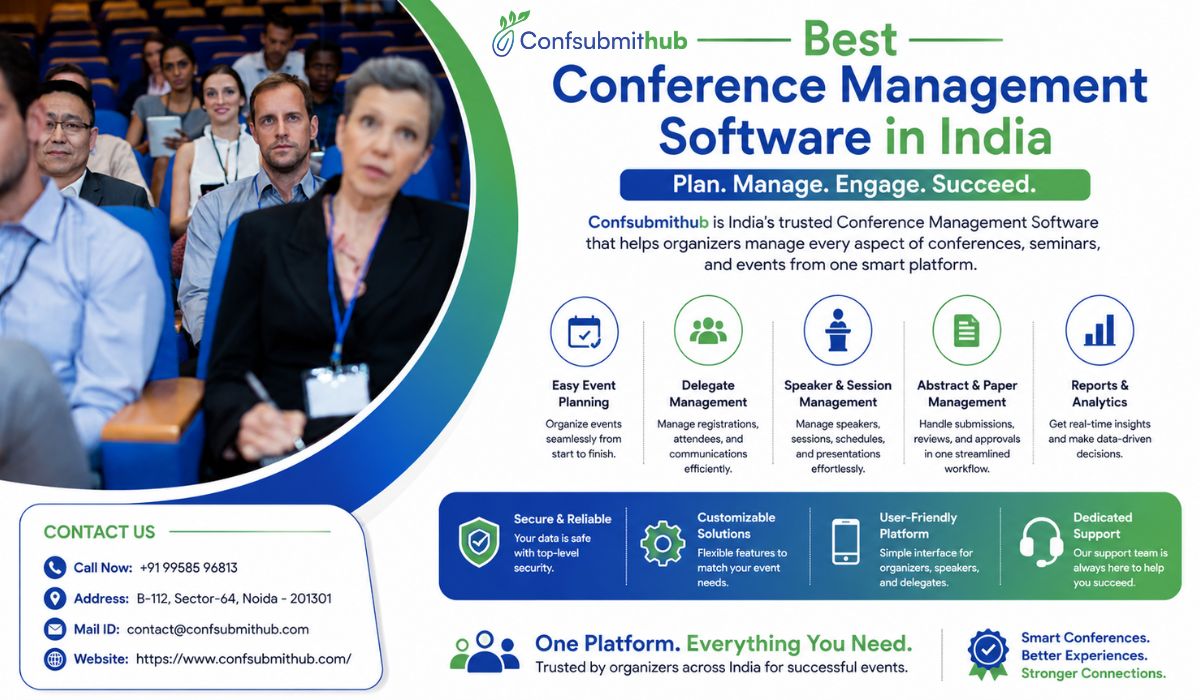
Running a conference involves a lot more than choosing a date and booking a venue. Abstracts have to be collected, authors need updates, papers need to be reviewed, and speakers and sessions have to be coordinated. When these details are sitting across spreadsheets, email threads, and separate documents, keeping everything updated can become a real chore. The best conference management software in India can bring much of this work together, giving organizers one place to follow submissions, reviews, speakers, and the final agenda.
From Abstract Submission to Conference Planning
Abstract submission is often where the planning really starts. Authors need a clear way to send their work, while the organizing team has to collect the required details, watch deadlines, and keep track of incoming submissions.
That sounds manageable with a small number of submissions. Things can change quickly when hundreds of abstracts start coming in. Files get saved in different folders, emails pile up, and someone has to keep checking the spreadsheet for the latest update.
Instead of checking three or four files just to find one submission, the organizing team can see the relevant details in one place.
1. Simplifies Abstract Submission
Authors should know exactly what they need to provide when submitting an abstract. A structured form can collect details such as the title, author names, affiliations, topic, abstract, and other information required for the conference.
Once submitted, those details stay with the relevant entry. The organizing team doesn’t have to copy the same information into another spreadsheet later. It may seem like a small convenience, but when there are hundreds of submissions, it can save a fair amount of time.
2. Makes Review Management More Organized
The review stage is another area where manual tracking can become difficult. Several reviewers may be working on different submissions, and keeping up with who has received what isn’t always easy through email alone.
Conference management software can keep reviewer assignments and submissions together. Organizers can send the relevant papers to reviewers, while reviewers can access their assigned work and add comments or recommendations.
If an organizer needs to check whether a particular abstract has been reviewed, they don’t have to search through old email conversations. The status can be checked directly in the system.
3. Helps Organize Accepted Papers and Speakers
After the reviews are complete, the focus shifts to the accepted papers and the people presenting them. Organizers need to know which submissions have been accepted, who the speakers are, and how each presentation will fit into the program.
Having these details available during the planning stage can make the next step much less messy. Details already collected during submission and review can be used while organizing speakers, presentation formats, and sessions.
Changes are easier to handle as well. A speaker might become unavailable, or a presentation could need to move to another session. Having the information in one system means the organizer has a clearer starting point when making those adjustments.
4. Keeps Conference Information in One Place
There is a lot of information moving around during conference preparation. Submission records, reviewer decisions, speaker details, session information, and schedules all need to match.
When each item is stored separately, it becomes easier to open an old file or miss a recent change. Instead of checking different files for updates, the organizing team can go back to the same system and see the latest information.
It can also make things simpler for participants. Authors, reviewers, and speakers can access the parts of the process they actually need, instead of dealing with information that doesn’t concern them.
5. Reduces Last-Minute Administrative Work
A well-organized workflow can reduce repetitive administrative tasks. Instead of repeatedly copying information between spreadsheets and documents, organizers can work with information already stored in the system.
That matters when deadlines get close. Small administrative errors, such as an incorrect speaker name or misplaced presentation, can create unnecessary problems just before an event.
Building the Final Conference Agenda
Creating an agenda is often one of the more demanding parts of conference preparation. Sessions need suitable time slots, speakers need to be assigned, and presentations may need to be grouped according to topics or tracks.
The best conference management software in India can make this process easier by keeping submission and scheduling information connected. Organizers can use the available data to arrange sessions and build a clearer program.
For example, if several accepted papers belong to the same research topic, organizers can group them into a relevant session. Speaker availability and presentation duration can then be considered while preparing the timetable.
What Should You Check Before Choosing Conference Software?
Start by looking at the way your conference is actually organized. Does the software handle abstract submissions, reviewer assignments, speaker details, scheduling, registration, and communication? You may not need every feature, so focus on the ones your event team will use regularly.
Ease of use matters as well. Authors and reviewers may only log in when they need to submit or review something, while the organizing team may use the platform every day. A system that is simple to navigate can save a lot of unnecessary questions and support requests.
Bringing the Conference Workflow Together
The real advantage is having all these stages connected instead of managing each one in a separate file or system. An abstract submitted at the start may later become a reviewed paper, an accepted presentation, and finally part of a scheduled session. That connection also means organizers aren’t constantly rebuilding the same information in different files.
For organizers looking for the best conference management software in India, it makes sense to choose a platform that covers the workflow from submission and review through to scheduling and communication. ConfSubmitHub brings these activities into one platform, helping organizers manage submissions, reviews, speakers, and scheduling without switching between multiple systems.
To Know more visit here: https://www.confsubmithub.com/
FAQs
What is conference management software?
It is a platform that helps organizers manage tasks such as abstract submission, review, scheduling, speaker management, and conference communication.
How does software help with abstract submission?
It gives authors a structured submission process and allows organizers to collect and track submissions in one system.
Can conference software help with reviewer management?
Yes. Many platforms allow organizers to assign submissions to reviewers, collect feedback, and track review progress.
Can it help create the final conference agenda?
Yes. Conference software can help organizers organize accepted papers, speakers, sessions, and time slots when preparing the program.
What should organizers consider before choosing conference software?
Look at the submission and review workflow first, then check scheduling, communication, reporting, ease of use, and the support available from the provider.